CVE-2024-52291 — craftcms/cms
HIGHCVE-2024-52291 is a high-severity (CVSS 8.4) Path Traversal vulnerability in craftcms/cms. 1 public exploit reference exists, so weaponization risk is real. A fix is available for craftcms/cms — see the affected versions and patch details below.
Craft has a Local File System Validation Bypass Leading to File Overwrite, Sensitive File Access, and Potential Code Execution
Exploitation Status
Proof-of-concept exploit code exists
- CISA’s SSVC triage found public proof-of-concept exploit code for this CVE, though no confirmed active exploitation.
- A successful exploit gives an attacker total control of the affected component, not partial access.
Exploitation and automatability from CISA’s SSVC triage for CVE-2024-52291.
EPSS Exploitation Probability
EPSS (Exploit Prediction Scoring System) is a daily probability model maintained by FIRST.org. It estimates the likelihood a CVE will be exploited in production environments within the next 30 days, derived from real-world threat intelligence signals.
How urgent is this, really
CVE-2024-52291 plotted by exploitation likelihood (EPSS) against impact (CVSS). The shaded corner — EPSS 50%+ and CVSS 7.0+ — is where this CVE doesn't sit, though severity or exploitability alone can still warrant action.
Where this sits among everything scored
Of 378,156 CVEs with a current EPSS score, this one falls in the < 10% band (highlighted). Real counts from FIRST.org, not a sample — log-scaled since the landscape is heavily right-skewed.
Real-World Exposure
craftcms/cms🐘craftcms/cmsReal-time download stats are indexed for npm and PyPI packages. This vulnerability affects Packagist packages — download data is not available via public APIs for these ecosystems.
Description
Summary
A vulnerability in CraftCMS allows an attacker to bypass local file system validation by utilizing a double file:// scheme (e.g., file://file:////). This enables the attacker to specify sensitive folders as the file system, leading to potential file overwriting through malicious uploads, unauthorized access to sensitive files, and, under certain conditions, remote code execution (RCE) via Server-Side Template Injection (SSTI) payloads.
Note that this will only work if you have an authenticated administrator account with allowAdminChanges enabled.
https://craftcms.com/knowledge-base/securing-craft#set-allowAdminChanges-to-false-in-production
Details
The issue lies in line 57 of cms/src/helpers/FileHelper.php, it only removes file:// on the most left. It is trivial to bypass this sanitization by adding 2 file://, e.g. file://file:////.
    public static function normalizePath($path, $ds = DIRECTORY_SEPARATOR): string
    {
        // Remove any file protocol wrappers
        $path = StringHelper::removeLeft($path, 'file://');

        // Is this a UNC network share path?
        $isUnc = (str_starts_with($path, '//') || str_starts_with($path, '\\\\'));

        // Normalize the path
        $path = parent::normalizePath($path, $ds);

        // If it is UNC, add those slashes back in front
        if ($isUnc) {
            $path = $ds . $ds . ltrim($path, $ds);
        }

        return $path;
    }
PoC
- Sign in with an admin account and navigate to
Settings → Assets, then create a new volume. - n the Asset Filesystem section, create a new file system and set the Base Path to
file://file:////vendor. Without the prefix, the selection fails.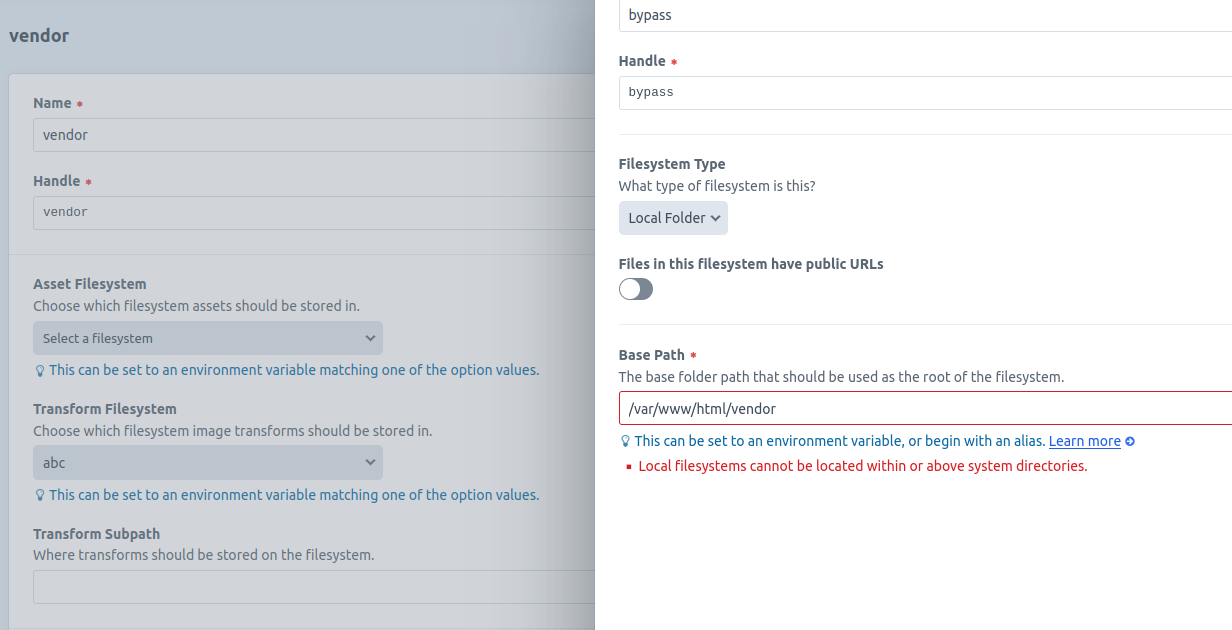 With the double
 file://prefix, the selection succeeds.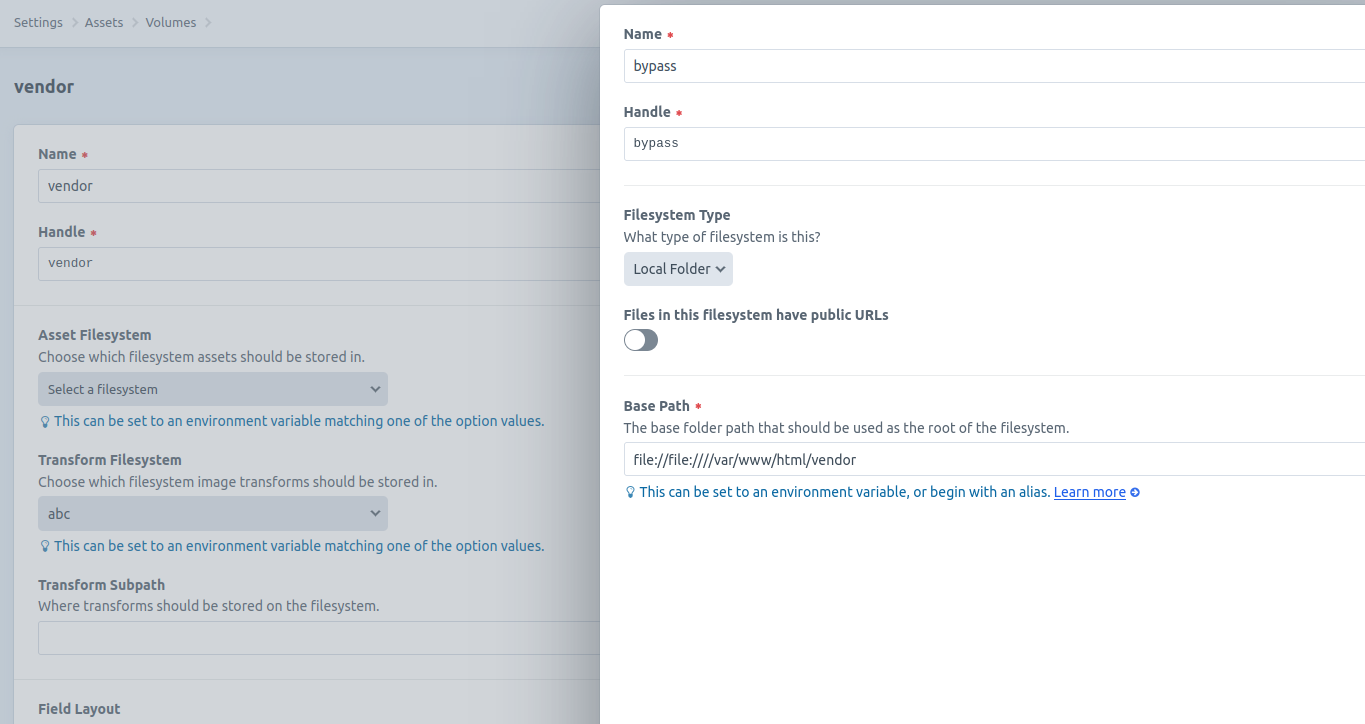
- Access Assets from the left navigation bar, then upload a file into this volume.
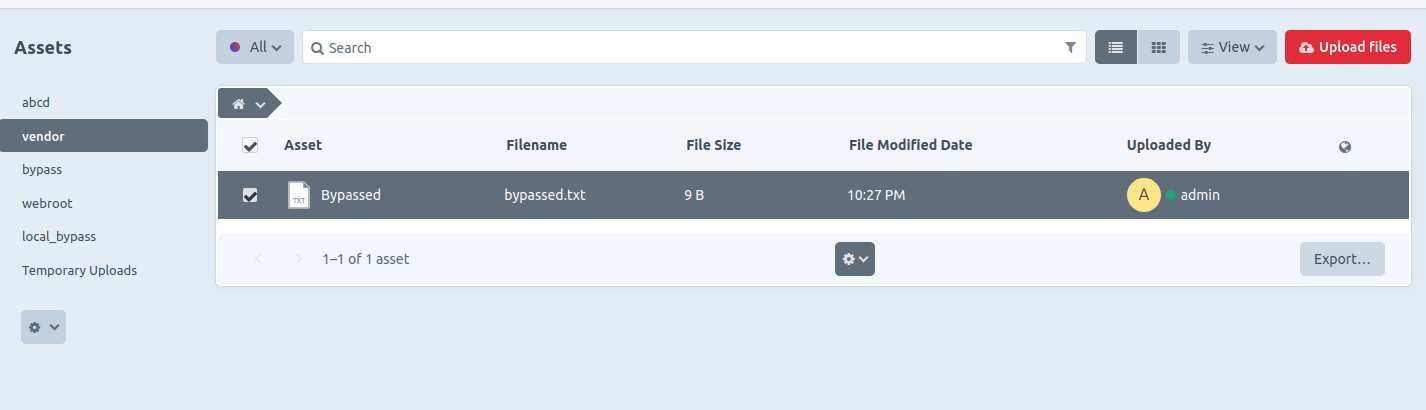
- The file is successfully uploaded and stored in the sensitive folder specified (e.g.,
/vendor).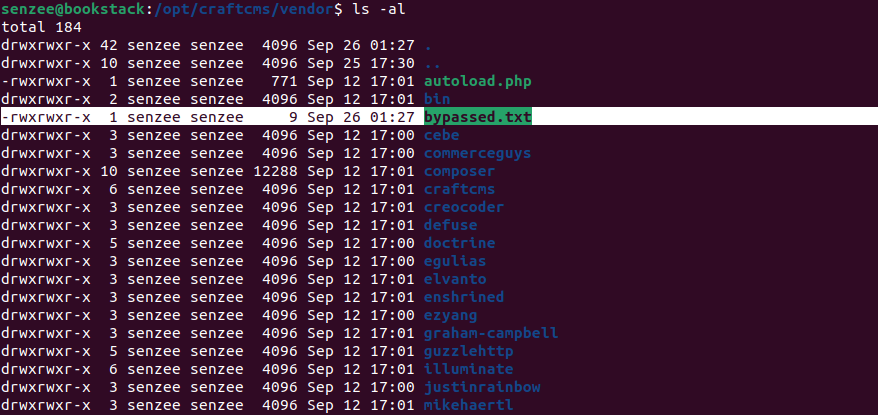
- SSTI payloads can be uploaded to
/templatesfolder, though full code execution was not achieved during testing, some payloads were still successful, leading to sensitive information disclosure, among other potential impacts.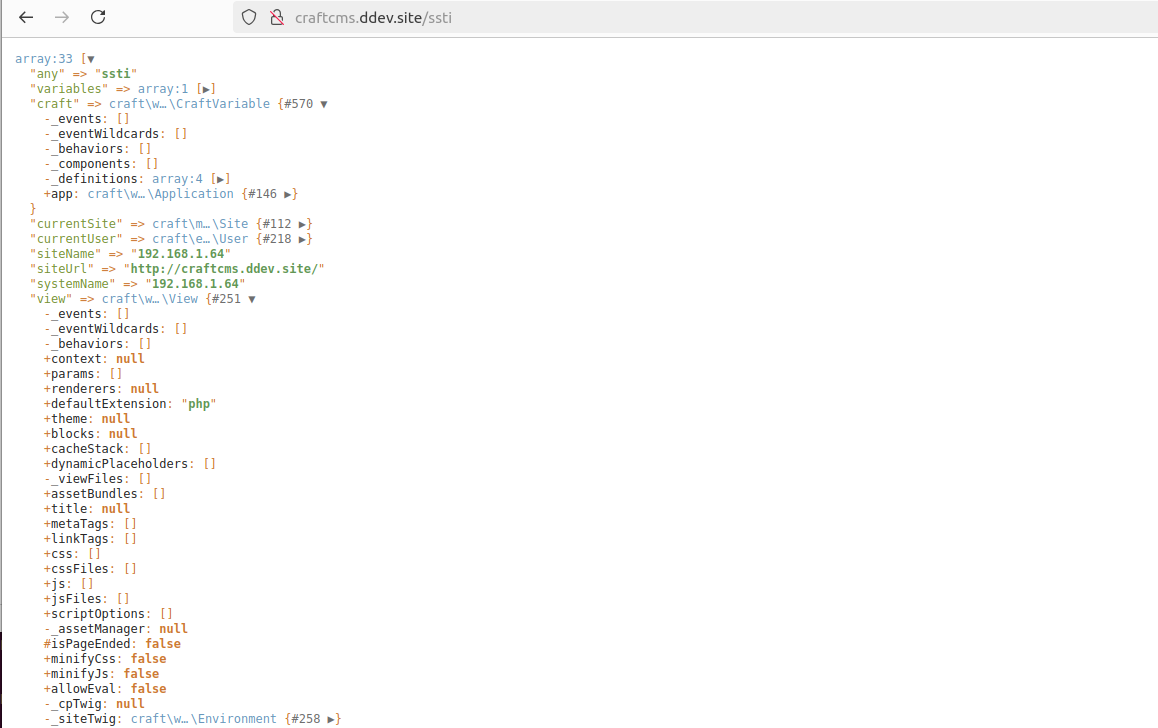
Impact
Attackers who compromise an admin account(The admin user is not equal to the server owner) can exploit this flaw to assign sensitive folders as the base path of the filesystem. For instance, if the path /templates is specified (e.g., file://file:////var/www/html/templates), the attacker could upload SSTI payloads. While CraftCMS includes strict SSTI input sanitization, RCE may still be possible if the attacker can craft a valid payload, as seen in similar vulnerabilities (e.g., GHSA-44wr-rmwq-3phw).
Additionally, attackers can upload tampered files to overwrite critical web application files. By enabling public URLs for files in the specified filesystem, they can also retrieve sensitive files (e.g., configuration files from the local file system).
Although the vulnerability is exploitable only in the authenticated users, configuration with ALLOW_ADMIN_CHANGES=true, there is still a potential security threat.
Affected Packages
| Ecosystem | Package | Vulnerable range | Fix |
|---|---|---|---|
| 🐘Packagist | craftcms/cms | ≥ 5.0.0-RC1&&< 5.4.6 | 5.4.6composer require craftcms/cms:^5.4.6 |
| 🐘Packagist | craftcms/cms | ≥ 4.0.0-RC1&&< 4.12.5 | 4.12.5composer require craftcms/cms:^4.12.5 |
Research use only. For defensive security, authorized penetration testing, and academic research only. Never execute exploit code against systems without explicit written authorization.
Detection & mitigation playbook
Open-source dependencyDetect
Scan your dependency tree (package-lock.json, pnpm-lock.yaml, requirements.txt, go.sum, etc.) for craftcms/cms, including transitive dependencies — a direct dependency you never call can still pull in a vulnerable version.
Fix
Update craftcms/cms to 5.4.6 or later, then make sure no transitive (indirect) dependency still pins the vulnerable range — O3 confirms CVE-2024-52291 is resolved across your whole dependency graph.
Workarounds
If you can't upgrade right away: gate or disable the affected feature, validate untrusted input at the boundary, and avoid passing attacker-controlled data into the vulnerable path. O3's runtime protection blocks exploitation in production as an interim safeguard until the upgrade lands.
How O3 protects you
O3 Security's impact-aware SCA analyses which vulnerable code paths your application actually calls, so a match like CVE-2024-52291 can be triaged on real exposure rather than presence alone.
Tailored to CVE-2024-52291. Runtime protection reduces exposure until a permanent patch is applied and verified — it complements patching, it doesn't replace it.
Frequently Asked Questions
Is CVE-2024-52291 in your dependencies?
O3 Security finds CVE-2024-52291 across Packagist dependencies, including transitive ones, and its impact-aware SCA ranks findings by whether your code actually calls the vulnerable path.